The morning America stopped flying
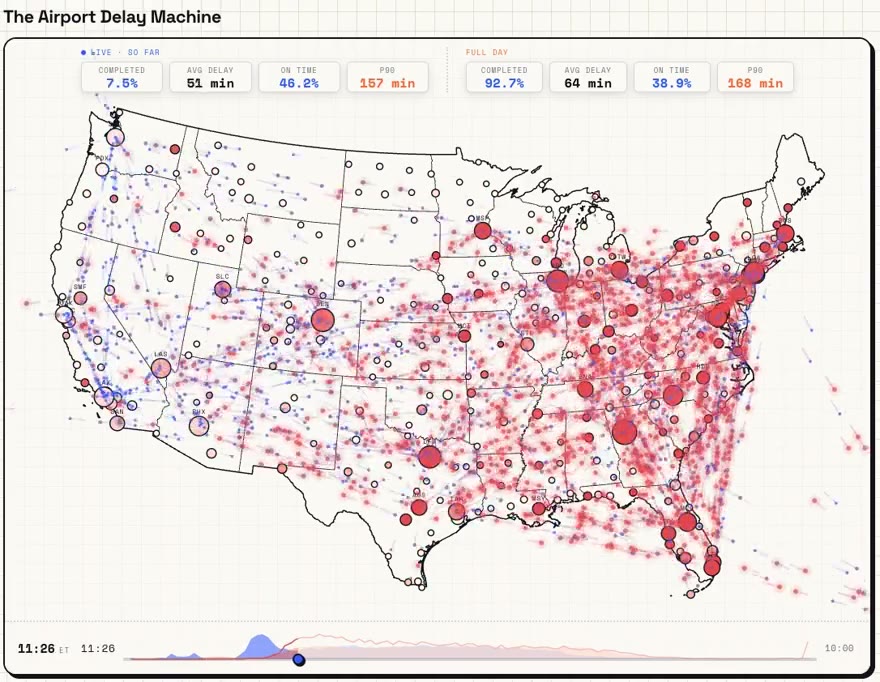
January 11, 2023: the first nationwide ground stop since 9/11, replayed from 17,267 flight records.
Where this came from
Thomas's whole argument in Episode 1 is that airport delays are "incomprehensible variability": too many causes, tangled too deep to model. While building the episode's delay-cascade simulation we went looking for the one day in the record where cause and effect are perfectly legible. This is that day. One system failed, every airport froze at once by decree, and then 23 years of federal per-flight data let us watch, minute by minute, how the country thawed. It is the cleanest natural experiment in the dataset, and the purest picture of the show's thesis: delay is not weather, it is a network passing lateness downstream.
What happened
Overnight, the FAA's NOTAM system went down. NOTAMs are the feed that warns pilots about runway closures and hazards; no feed, no safe departures. At 7:30 a.m. Eastern the FAA paused every domestic departure in the country, the first nationwide ground stop since September 11, 2001. The cause, per the FAA's own review: contract personnel unintentionally deleted files while syncing the live database with its backup. Not a cyberattack. One file sync grounded a continent.
The numbers
- 17,267 scheduled domestic flights that day.
- At 8:15 a.m.: 1,352 flights stuck on the ground, and 5 departures in the previous 15 minutes across the entire country. A normal morning runs about 500.
- The flush comes at 9:15-10:00, then the backlog bleeds west all afternoon as late aircraft carry it from airport to airport.
- Day totals: 59% of departures 15+ minutes late and 7% cancelled, against 14% and 1% on the surrounding days.
One honest footnote: the map is not green before 7:30, because the system had been rotting since the previous evening as the outage brewed. The ground stop is not the moment things went bad. It is the moment bad became frozen.
When was the last time the US grounded all flights?
January 11, 2023 — this morning — and before that, September 11, 2001. That is the entire list. The federal on-time record we replay here runs back to 2003, 150+ million flights, and it is full of terrible mornings — Winter Storm Elliott, the Southwest collapse, the CrowdStrike outage — but those are one airline or one region rotting outward. This is the only day in the dataset where every airport on the map stops at once by federal order: the closest thing the record has to a controlled experiment, one input switched off, 17,267 flights as the readout.
How long did the 2023 ground stop last?
About an hour of near-silence, and a whole day of consequences. The FAA's order came at 7:30 a.m. Eastern. By 8:15 the country was down to 5 departures in 15 minutes, with 1,352 aircraft holding on the ground. Departures don't return in volume until the 9:15–10:00 flush, when everything that had been parked tries to leave at once. When this day comes up cold in the episode, Eric's read on tape is the right one: "there's almost an hour of no flights taking off… it's literally an hour across the whole country." The precision is the giveaway. Weather doesn't switch a continent off at one minute and back on at another. A database does.
How long did it take flights to recover after the ground stop?
The stop lifted mid-morning; the delays did not. The 9:15–10:00 flush clears the parked aircraft, but every one of those planes departs late and then arrives late somewhere else, so the backlog rides west all afternoon inside the aircraft themselves. That's why the day closes at 59% of departures 15+ minutes late and 7% cancelled while the surrounding days ran 14% and 1%. The only real cure was the night — the loop ends where it began, 4 a.m. and an empty map, because a plane that sleeps at a gate wakes up with nothing to inherit. It's the mechanism that rules ordinary bad days too — late-arriving aircraft account for 39.2% of US delay minutes, extreme weather 6.4% — the ground stop just ran it with the cause labeled in advance.
Was the NOTAM outage a cyberattack?
No. The FAA's own review found that contract personnel unintentionally deleted files while syncing the live NOTAM database with its backup. No attacker, no storm — a file sync. The system that grounded a continent wasn't the weather layer or the security layer, it was the plumbing. In the episode the stat line for this day reads 38% on time, and Thomas's first guess on seeing the map melt was "Is that a weather event?" Reasonable guess — and the one the record keeps refusing. You can load January 11, 2023 yourself in the interactive model and watch it happen.
Check it yourself
The parquet files are free on our data page. The day against its neighbors, in one query:
SELECT day_of_month AS jan_day,
       round(100.0*avg(coalesce((dep_delay >= 15)::int, 0)), 1) AS pct_late,
       round(100.0*avg(cancelled), 1)                           AS pct_cancelled
FROM read_parquet('https://data.mathvsvibes.com/bts/bts_2023.parquet')
WHERE month = 1 AND day_of_month BETWEEN 9 AND 13
GROUP BY 1 ORDER BY 1;
Receipt trail: posted on r/ScienceNcoolThings (108 points) and r/datavisualization. Sources: US DOT/BTS on-time data (public domain) · FAA NOTAM statement · NPR coverage.